
The Invisible NDA Many Punjabi Daughters Signed on Their Wedding Day
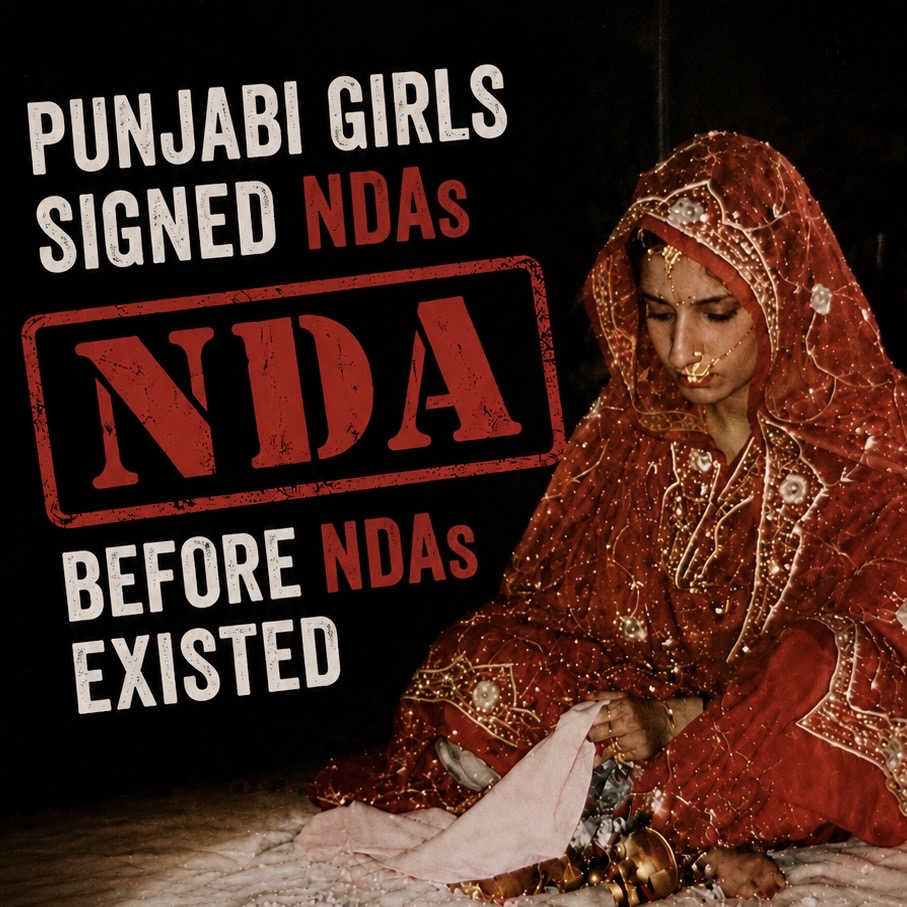
For generations, many Punjabi daughters left home carrying far more than a wedding trousseau. Alongside the jewellery, embroidered suits and carefully packed memories of childhood sat an invisible agreement that had been passed down from one generation of women to the next. Nobody ever wrote it down and nobody ever asked them to sign it, yet they understood its terms all the same. What happened after marriage was expected to remain within the four walls of their new home, no matter how difficult life became, because protecting the family’s reputation was often considered more important than protecting their own wellbeing.
Many young women entered marriage believing that compromise, patience and understanding were the foundations of a successful relationship, which of course they are. The problem arose when compromise only seemed to travel in one direction and when patience became a requirement placed almost exclusively upon the daughter-in-law. If she was unhappy, she was encouraged to adjust. If she disagreed with something, she was encouraged to stay quiet. If she felt hurt or isolated, she was reminded that marriage was never easy and that every woman before her had somehow managed to endure similar challenges.
When conversations about family relationships take place today, there is often a tendency to focus on difficult daughters-in-law. Social media is filled with stories about women who are supposedly controlling, disrespectful or determined to create distance between husbands and their families. Whilst such situations undoubtedly exist, they tell only a small part of a much larger story. Far less attention is given to the daughter-in-law who spends years trying to fit in, trying to gain approval and trying to avoid upsetting anyone, only to discover that no amount of effort ever seems quite enough.
The daughter-in-law nobody talks about is often the woman who arrives with the very best intentions. She wants to build strong relationships, create happy family memories and contribute positively to the lives of those around her. She remembers birthdays, attends family gatherings, buys thoughtful gifts and makes a genuine effort to understand traditions and customs that may differ from those she grew up with. She wants her husband’s family to like her because, despite what some people assume, most women do not enter marriage looking for conflict. They enter marriage hoping to belong.
Yet belonging can sometimes feel surprisingly difficult.
Every family has its own culture, its own unwritten rules and its own expectations, many of which are so deeply embedded that family members no longer recognise them as expectations at all. A daughter-in-law may find herself being judged against standards she never knew existed, whether it is the way she cooks, the way she dresses, the way she raises her children or the amount of time she spends with different branches of the family. The challenge is made even harder because these expectations are rarely explained openly. Instead, they often emerge through subtle comments, comparisons or disappointments that leave her constantly wondering whether she has somehow got things wrong.
What makes this particularly interesting is the contrast between the way daughters-in-law and sons-in-law are often treated. Whilst daughters-in-law are frequently expected to become daughters overnight, sons-in-law are generally allowed to remain sons-in-law. They are welcomed warmly, included in family celebrations and given the freedom to maintain a degree of distance without attracting criticism. Nobody expects them to telephone every day, attend every gathering or immediately understand every family tradition. Yet many daughters-in-law find themselves carrying responsibilities and expectations that extend far beyond simply being a spouse.
This is not intended as criticism of mothers-in-law or of older generations, many of whom navigated challenges far greater than those faced today. In fact, some of the strongest advocates for younger women are mothers-in-law who remember exactly what it felt like to be a new bride themselves. They remember the loneliness, the uncertainty and the pressure of trying to make a good impression whilst missing the comfort of their own parents and siblings. They remember what it was like to have very few places where they could speak honestly about their experiences without being judged.
The reality is that many women have spent decades carrying stories that were never told. They learned to smile through difficulties, to keep family matters private and to convince themselves that everyone else seemed happier than they were. Some eventually found their voice, whilst others simply became accustomed to putting their own needs at the bottom of an ever-growing list of priorities. When we hear older women talk about resilience, we should remember that resilience is often another word for survival.
Thankfully, attitudes have begun to change. More parents are teaching their daughters that marriage should never require them to sacrifice their self-respect, and more families are recognising that healthy relationships cannot be built on silence. Younger women are increasingly willing to discuss subjects that previous generations felt unable to address, not because they are less committed to family life, but because they understand that strong relationships depend upon honesty rather than endurance.
Perhaps the most important lesson of all is that respect should never be viewed as a one-way transaction. A daughter-in-law should absolutely treat her husband’s family with kindness, courtesy and consideration, but she deserves those same qualities in return. She deserves to be seen as an individual rather than a role, to be appreciated rather than constantly assessed and to be accepted without feeling that she must spend years proving her worth.
The daughter-in-law nobody talks about is not usually the woman causing problems. More often than not, she is the woman quietly holding everything together whilst trying to balance the expectations of two families, maintain her own identity and build a happy life with the person she married. She is the woman who spends years giving her best to the people around her and hoping that, one day, somebody notices how hard she has been trying all along.