
Nazar - The curse we blame for everything 'Nazar Lag Gayi!'
Is it real? Is it lucky? Is it complete nonsense?
I’ve lost count of how many times I heard the words, ‘Nazar lag gayi’, growing up.
If a child fell over, it was nazar.
If someone suddenly became poorly, it was nazar.
If the car broke down the week after you bought it, it was definitely nazar.
The whole concept of the evil eye has fascinated me for years.
According to Google, the belief essentially revolves around the human aura, an energy field surrounding each person that can be affected by the thoughts, envy or negativity of others.
Now, whether you believe in auras or not, one thing does make sense to me. We’ve all walked into a room and instantly felt uncomfortable without anyone saying a word. We’ve all met people whose negativity seems to fill a space before they’ve even opened their mouths.
So perhaps there is something to be said for the energy people carry.
Growing up in a Punjabi family, nazar wasn’t just something people talked about – it was something they actively fought against.
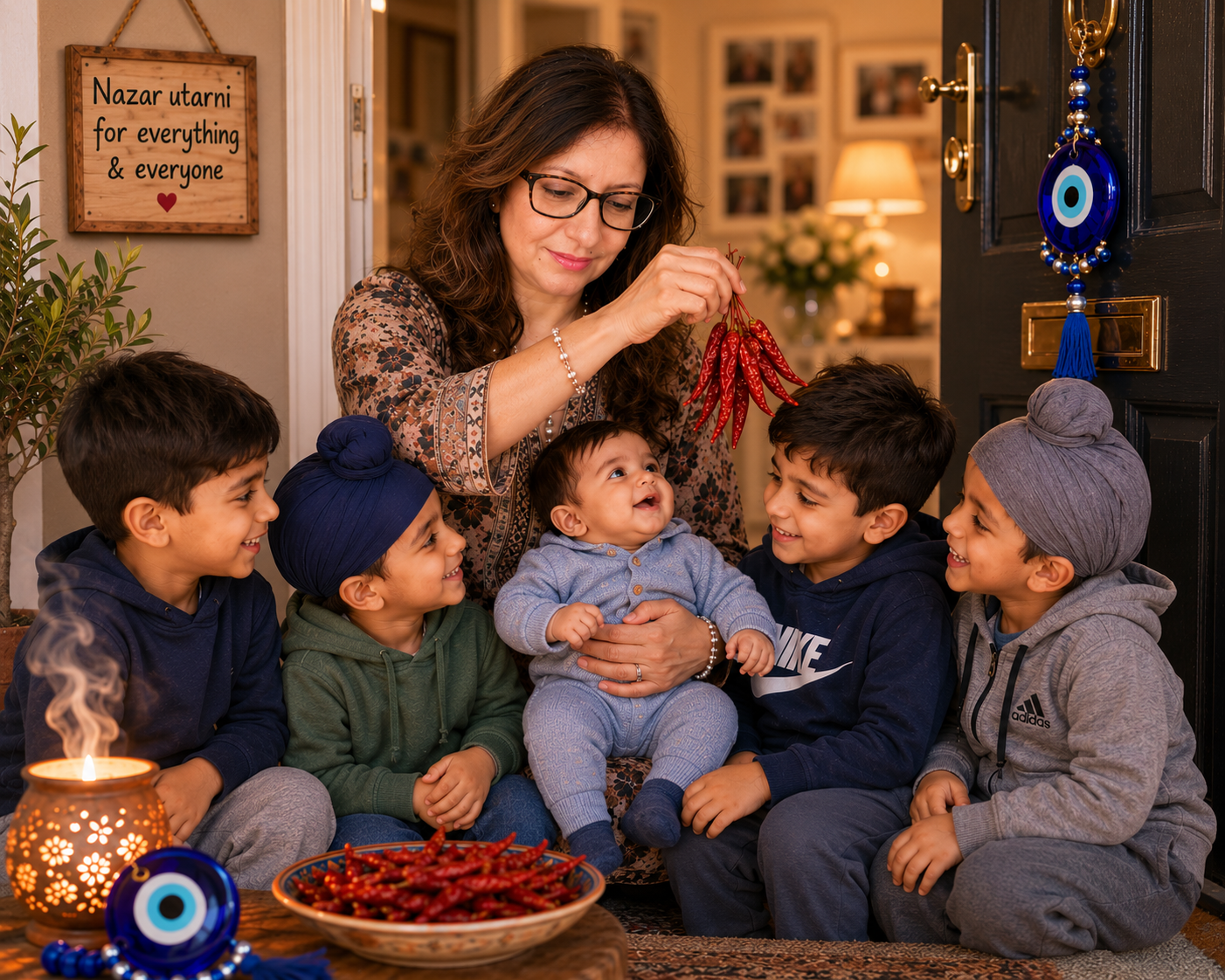
My Mum and Dad were constantly trying to remove the evil eye from me and my siblings. ‘Nazar utarni’, as it was known, was almost a weekly occurrence in our house.
Dad would never allow my sister and I to leave the house together. He was convinced we attracted nazar too easily and would insist that one of us left a minute before the other. Little did he know that whoever left first simply waited at the corner of the road until the other caught up.
The funny thing is that my Dad was probably the least superstitious person I knew. He believed in hard work, common sense and taking responsibility for your own life. Yet this was the one belief he never seemed willing to let go of.
Mum had her own methods, most evenings, when we came home from school, she would be waiting with five dried red chillies. She would move them around our heads several times before throwing them onto an open flame. In our case, the flame was usually the gas hob in the kitchen. If she happened to be out of chillies, she would light a stick of incense and slowly move it in circles around our heads instead. Looking back now, my family sounds completely bonkers.
And then I got married, and discovered my mother-in-law was exactly the same. The moment one of my children bumped their head, became unsettled or developed a temperature, out would come the rituals to remove nazar.
Fast forward thirty-five years and here I am doing exactly the same thing.
Every time one of my grandchildren falls over, gets a scrape or something unfortunate happens, there I am with – ‘Hai, nazar lag gayi’! Meanwhile, my children stand there rolling their eyes while trying to comfort the screaming child. ‘For God’s sake, Mother!’, they mutter. Yet somehow I carry on regardless…
Punjabis have all sorts of ways of protecting against nazar. Some tie black threads around a baby’s wrist or ankle. Others place a black dot behind a child’s ear. You’ll find blue nazar battus hanging from rear-view mirrors, front doors, prams and even expensive new kitchens. Others
In our family, a small handful of ajwain and salt would be placed together in the palm of the hand and moved around the person’s head several times, usually seven, while prayers or blessings were quietly spoken. The mixture would then be thrown onto a flame or discarded outside the home, taking the nazar with it. Whether it actually removed anything is anyone’s guess, but generations of Punjabi mothers, grandmothers and aunties swore by it.
Many people will say ‘Waheguru mehr kare’ after complimenting a child, almost as a way of balancing the praise. Others still swear by red chillies, salt, mustard seeds or incense. The funny thing is that many of the same people who claim not to believe in superstition still hang a nazar battu somewhere in their home.
Just in case….perhaps that’s because nazar isn’t really about magic at all. Maybe it’s simply our way of acknowledging that jealousy exists, that not everyone wishes us well, and that negative energy can sometimes affect us more than we’d like to admit.
Or perhaps it’s just another one of those wonderful Punjabi traditions that has travelled from villages in Punjab to Southall, Birmingham, Derby, Vancouver and beyond.
As for me, I’m still not entirely sure. What I do know is that three generations of my family have believed in it, and despite all my logic and common sense, I still find myself removing nazar from my grandchildren whenever they have a tumble…old habits die hard.
So tell me, do you believe in nazar? Have you had experiences that made you think there might be something in it? Or do you think it’s simply a tradition passed down through generations?
I’d love to hear your thoughts on this.